Simulations and Observations of Uranus and Neptune's atmospheric Dynamics (SOUND): a 5-year project funded by the French ANR
Context and objectives
This project seeks to deepen our understanding of the atmospheric dynamics of Uranus and Neptune, the Solar System's two enigmatic "ice giants." Despite their significance as archetypes for a widespread class of exoplanets, these planets remain poorly understood, with only a single flyby mission (Voyager 2) conducted nearly four decades ago. Our project focuses on unraveling key atmospheric processes, including small-scale convective and storm activity, large-scale circulation patterns, the transport of trace species, the influence of wave dynamics, potential seasonal variations, and the thermal structure of their atmospheres. Recent advancements in supercomputing now enable high-resolution climate simulations, while the ALMA interferometric network provides unprecedented opportunities to probe the poorly constrained stratospheric winds of these distant worlds. The project’s core objectives include developing advanced 3D atmospheric models tailored to Uranus and Neptune. These models will help explore the physical and dynamical mechanisms driving their observed thermal and wind structures, as well as predict atmospheric behavior in regions that remain poorly observed. Additionally, the project aims to conduct comparative planetology experiments to identify the dominant forcings shaping the winds on these planets. Finally, by leveraging ALMA’s submillimeter interferommetric capabilities, the team seeks to derive new constraints on Neptune’s stratospheric winds and temperatures, further bridging the gap in our knowledge of these fascinating ice giants.
Methods
We combine modelling work and analysis of observations:
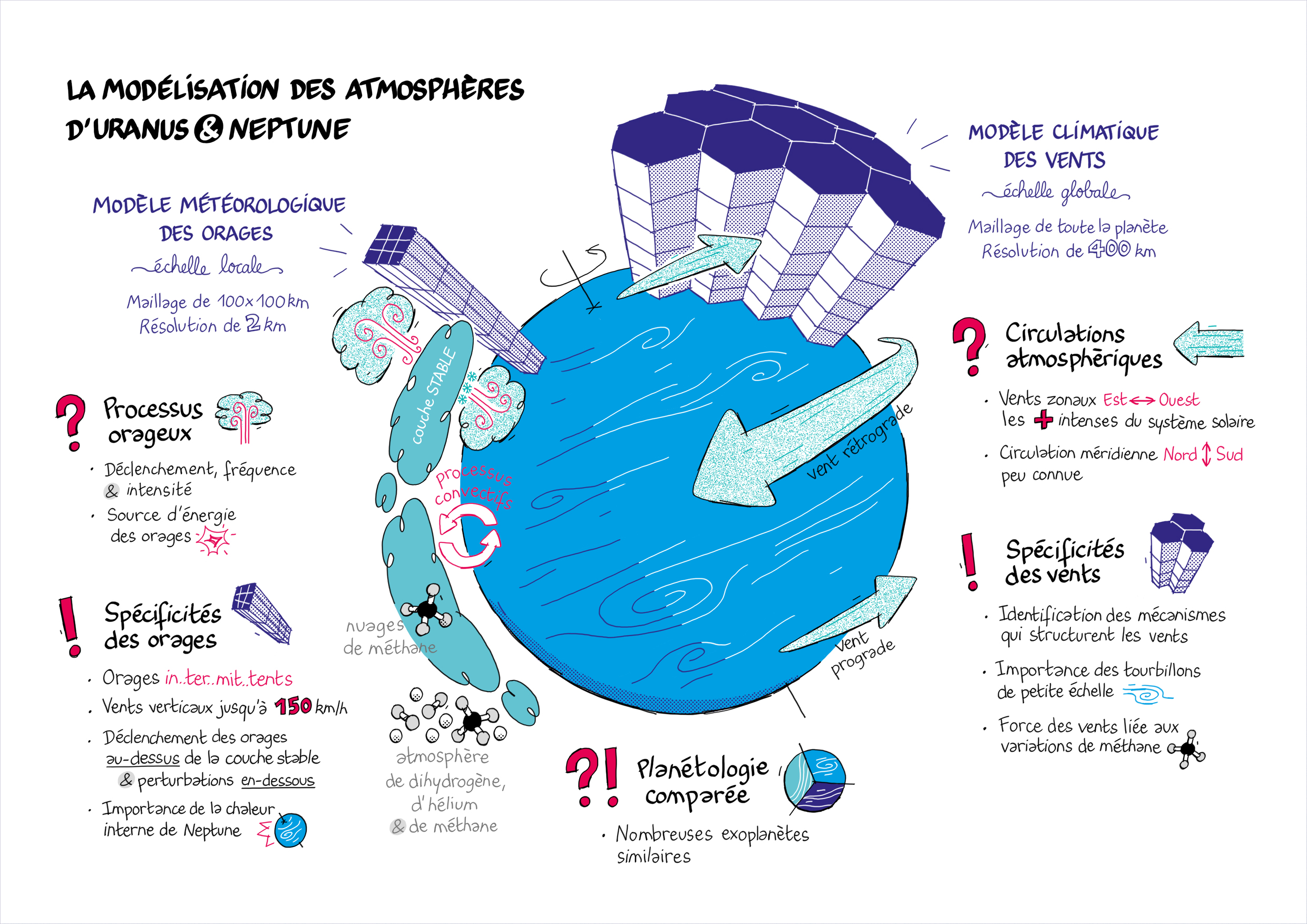
- We develop a general circulation model (GCM) of Uranus and Neptune, based on the Generic Planetary Climate Model. It is a 3D model covering the entire globe, on an atmospheric shell ranging from 10 bars to ~0.1 mbar. This model is based on an icosahedral mesh (the 3D DYNAMICO core) and simulations are performed at a spatial resolution equivalent to 1° and 2°. These simulations are analyzed using post-processing tools to study wave-flow interactions, zonal and meridional circulation, and various terms of heating and wind acceleration.
- We also develop another type of 3D model, called a Cloud Resolving Model (CRM). Contrary to the GCM, this model considers a local domain, typically 100 km wide with a 2 km mesh size (compared to a mesh size of ~500 km in the GCM) and employs a non-hydrostatic formulation. This set-up is adapted to the explicit resolution of small-scale convective processes — not resolved by the GCM grid — and is used to study storm's activity (intensity, frequency, mechanisms) on these methane-cloud planets.
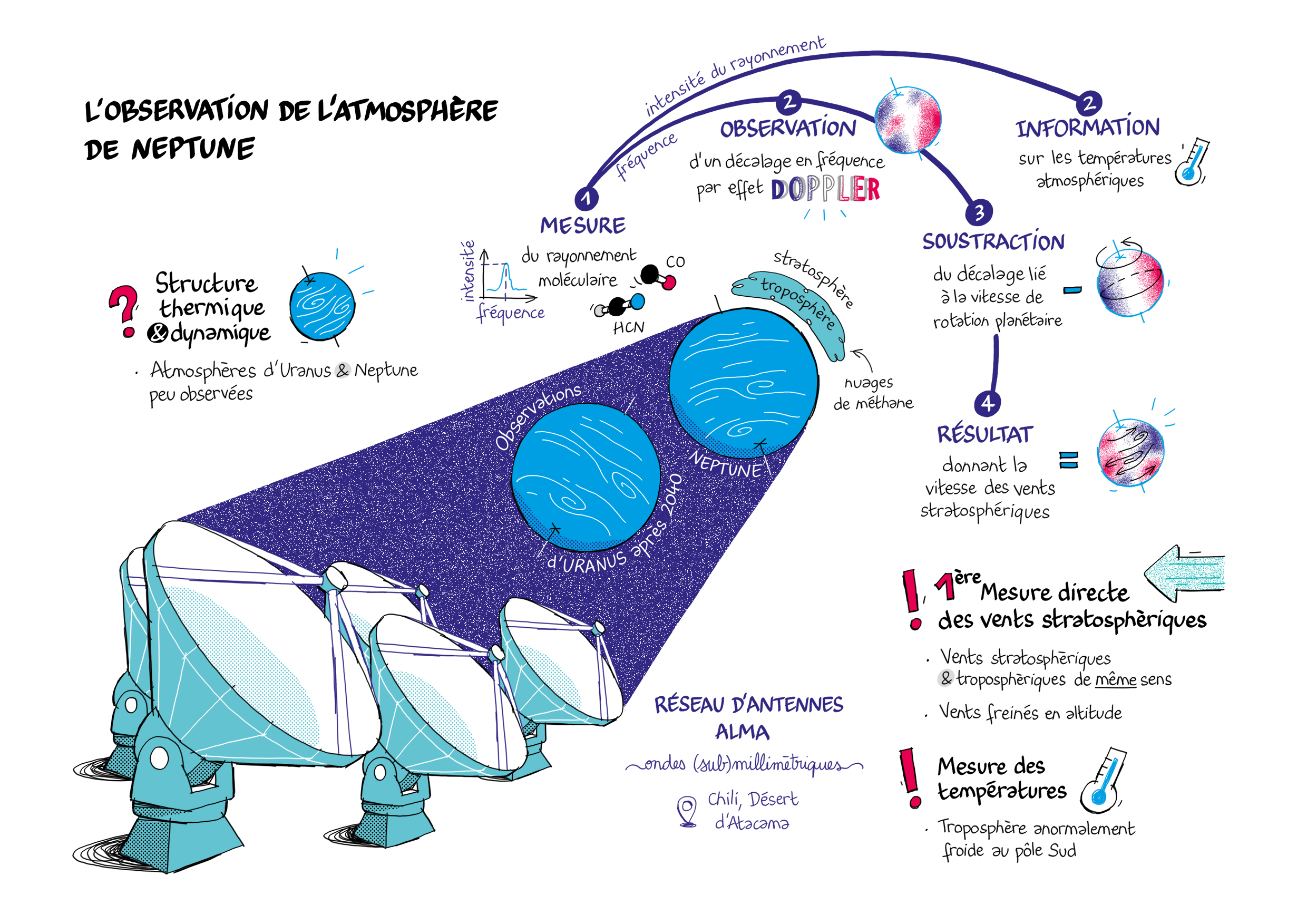
- Finally, we conduct analysis of submillimeter observations with ALMA to obtain new information on winds and temperature. Firstly, the Doppler shift of CO and HCN lines is evaluated and interpreted in terms of stratospheric wind speed along the line of sight. Secondly, a radiative transfer model is used to determine the altitude-pressure section of the temperature that best corresponds to the intensity and shape of the molecular lines.
Illustrations of the project (in French):
Team
Collaboration between three research teams at the Laboratoire de Meteorologie Dynamique (LMD), the Laboratoire d'Astrophysique de Bordeaux (LAB) and the LESIA/Observatoire de Paris :- Sandrine Guerlet, CNRS researcher at LMD
- Aymeric Spiga, professor at Sorbonne Université and researcher at LMD
- Ehouarn Millour, research engineer, LMD
- Jérémy Leconte, CNRS researcher at LAB
- Thibault Cavalié, CNRS researcher at LAB
- Emmanuel Lellouch, Astronomer at LESIA
- Raphaël Moreno at LESIA
- Noé Clément, former PhD student at LAB (2021-2024), now postdoctoral researcher at IPSL
- Gwenaël Milcareck, former PhD student at LMD (2020-2023), now postdoctoral researcher at IAA
- Oscar Carrion-Gonzalez, former postdoctoral researcher at LESIA, now postdoctoral researcher at MPI
- Arthur Le Saux, former postdoctoral researcher, now at CEA
News and publications:
- Publication by Oscar Carrion-Gonzalez et al., 2023: Doppler wind measurements in Neptune's stratosphere with ALMA
- Publication by Gwenaël Milcareck et al., 2024: : Radiative-convective models of the atmospheres of Uranus and Neptune: heating sources and seasonal effects
- Publication by Noé Clément et al., 2024: Storms and convection on Uranus and Neptune: impact of methane abundance revealed by a 3D cloud-resolving model
- Publication by Jérémy Leconte et al., 2024: A 3D picture of moist-convection inhibition in hydrogen-rich atmospheres: Implications for K2-18 b
- Noé Clément defended his PhD in October, 2024. Congratulations!
- Gwenaël Milcareck defended his PhD in November, 2023. Congratulations!
Funding
ANR, "Programme de Recherche Collaborative", 2021-2025 (ANR-20-CE49-0009).